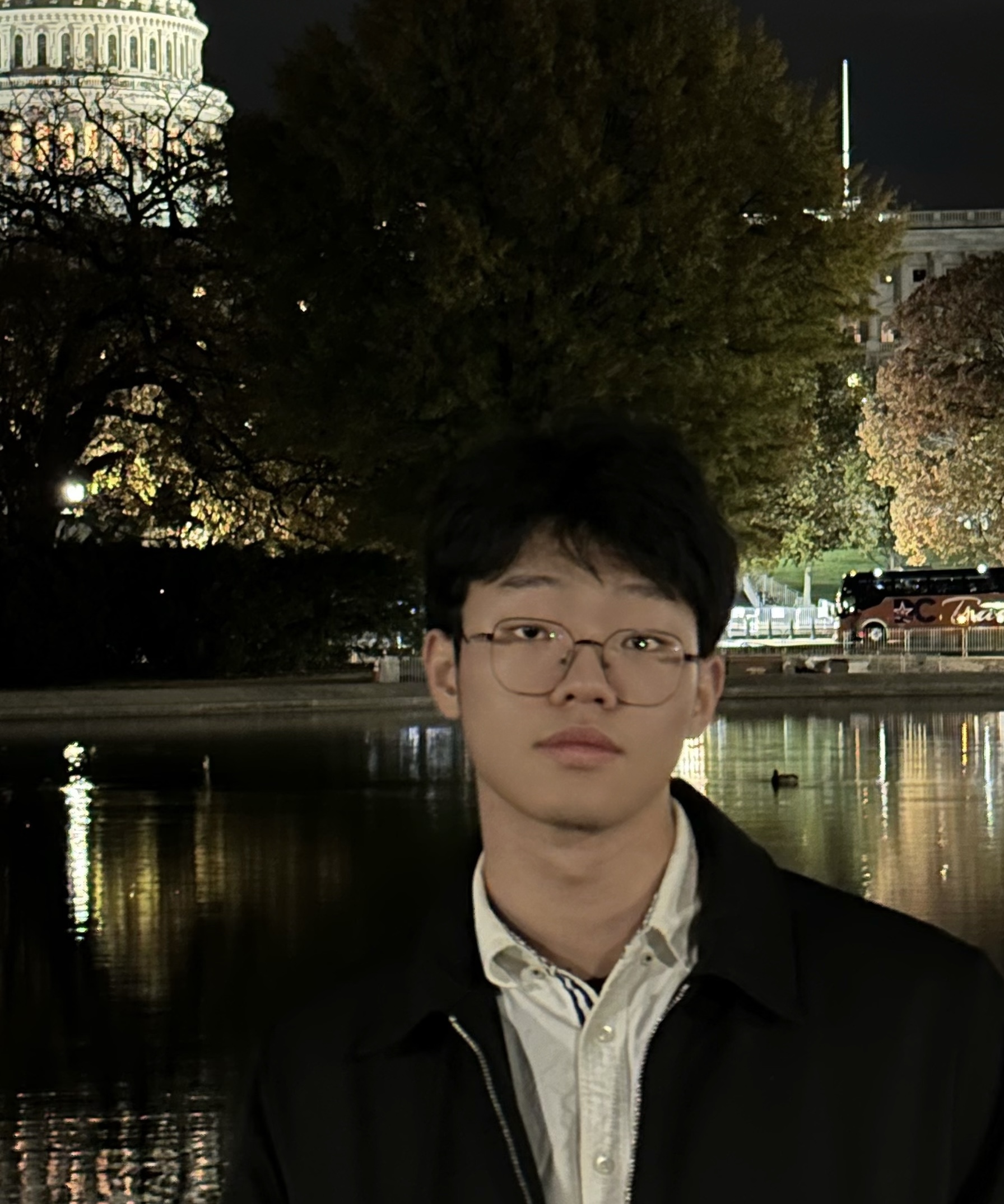
Bio
My name is Zeng, Hanyu, and I am currently a third-year Ph.D. student in Information Science at the University of Pittsburgh (PITT), under the supervision of Prof. Zhou, Pengfei in MINT lab. My research interests lie at the intersection of artificial intelligence and computer science, with a particular focus on Mobile AI, AI applications in healthcare, and the integration of Large Language Models in mobile contexts. My current research focuses on utilizing cutting-edge artificial intelligence technology to improve the health and lives of people with mobile devices and AI technologies.
I hold a Master’s degree in Intelligent Systems from the National University of Singapore (NUS) and Bachelor’s degrees in Communication Engineering from the University of Electronic Science and Technology of China (UESTC). Before joining the University of Pittsburgh, I worked as a Machine Learning Algorithm Engineer at MEITUAN and also a research intern in ILLINOIS ARCS under the supervision of Prof. Zhou, Pengfei and Prof. Lou, Xin during my master education.
News
I am starting my Research Scientist Internship in Mitsubishi Electric Research Laboratories (MERL) in Cambridge, MA from Feb to May, 2025, focusing on anomaly detection in IoT systems and cybersecurity.
Newest work ViPoser: Sparse-IMU Based Human Pose Estimation with Distilled Vision Foundation Priors has been accepted at MobiCom 2026. [PDF]
Signals in mobile and IoT systems are just numeric time series, which makes it hard for current ML models to learn the background knowledge behind a task — instead of understanding what they are working on, they simply learn an input-to-target mapping. Visual data, by contrast, carries far richer information such as human structure and kinematics.
A question naturally follows: is it possible to extract and purify this high-level knowledge and inject it into the corresponding mobile model? We explore this on the challenging task of sparse-IMU human pose estimation. Through our tailored design, ViPoser goes beyond the limited constraints of sparse-IMU input by leveraging anatomical priors as an additional source of supervision — achieving both higher accuracy than the baselines and more physiologically plausible poses.
Thanks to Prof. Zhou and Ji Hui for their valuable guidance and support on ViPoser!